
Choosing the right hair colour service isn’t always easy. With so many professional options available – including balayage, highlights, full head colour, root retouch, toner and colour correction – it’s natural to wonder which one is right for your hair.
The best choice depends on more than the colour you like. Your natural hair colour, previous colouring history, hair condition, maintenance preferences and desired result all play an important role in achieving a beautiful, long-lasting finish while keeping your hair healthy.
Whether you’re planning your first colour appointment, refreshing your current look or correcting unwanted tones, understanding the difference between these services will help you book the most suitable treatment with confidence.
In this guide, you’ll learn what each professional hair colour service is, who it’s best suited for, when it’s recommended and how to choose the right option before booking your appointment.
Every head of hair is different, which is why professional salons assess your hair history and goals before recommending a colour service.
Which Hair Colour Service Is Right for You?
If you’re wondering whether you need balayage, highlights, a full head colour, a root retouch, a toner or colour correction, you’re not alone.
Many people book the wrong hair colour service simply because they don’t know the difference between them. While some services are designed to create a soft, natural look, others are better for covering grey hair, correcting unwanted tones or achieving a complete colour transformation.
The right choice depends on several factors, including your natural hair colour, previous colour history, hair condition, lifestyle and the result you’d like to achieve.
Not sure where to start? Begin by thinking about what you’d like to change most:
- I want a softer, natural-looking blonde.
- I want my hair to be brighter.
- I need to cover grey hair.
- My hair looks orange or brassy.
- I want to fix a previous colour.
Once you’ve identified your goal, choosing the right professional hair colour service becomes much easier.
In the sections below, we’ll explain each service, when it’s recommended and who it’s best suited for.
1. What Are You Trying to Achieve?
Before choosing a hair colour service, it’s important to think about the result you’d like to achieve rather than the name of the treatment itself.
Many professional colour services can appear similar, but each one is designed to solve a different problem. Choosing the right service starts with understanding your goal.
Ask yourself which of these best describes what you’re looking for:
- I want a soft, natural-looking blonde with minimal maintenance.
- I want brighter, lighter hair from root to ends.
- I need to cover grey hair or refresh my roots.
- My hair looks orange, yellow or brassy after colouring.
- I want to fix uneven colour or a previous colour that didn’t turn out as expected.
- I’d like a completely new hair colour or a dramatic transformation.
Your answers will help determine which professional hair colour service is most suitable for your hair type, colour history and long-term maintenance.
In the next sections, we’ll explain each service in detail, including when it’s recommended, who it’s best suited for and the type of results you can expect.
Why your hair history matters
The same hair colour service can produce very different results depending on your hair’s history. Previous box dyes, bleach, henna, keratin treatments, natural hair colour and your hair’s overall condition all influence which service is the safest and most effective choice.
For this reason, experienced colourists assess your hair before recommending a treatment rather than suggesting the same service for everyone.
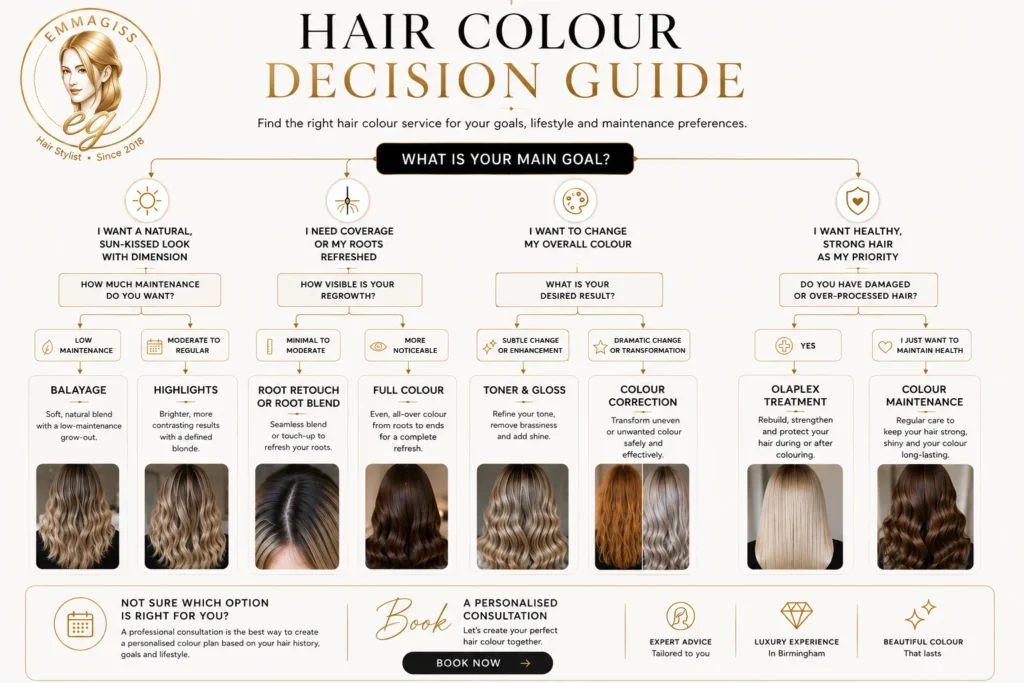
Which Hair Colour Service Matches Your Goal?
Choosing the right hair colour service becomes much easier when you focus on the result you’d like to achieve rather than the name of the treatment.
Use this quick guide to find the service that best matches your hair goals.
| If your goal is… | The service to consider |
|---|---|
| A soft, natural-looking blonde with low maintenance | Balayage |
| A brighter blonde from root to ends | Full Head Highlights |
| Brightness around your face | Partial Highlights or Money Piece |
| Seamless grey coverage | Full Head Colour or Root Retouch |
| Removing orange or brassy tones | Toner |
| Fixing uneven colour or a previous colour | Colour Correction |
| A complete colour transformation | Professional Colour Consultation |
Remember that this is only a general guide. Your previous colour history, natural hair colour and the overall condition of your hair will always influence which service is most suitable.
The sections below explain each treatment in more detail, including how it works, who it’s best suited for and what results you can expect.
2. Balayage – Best for a Soft, Natural & Low-Maintenance Blonde
Balayage is one of the most popular professional hair colour techniques because it creates a soft, natural-looking result with beautifully blended dimension. Rather than applying colour from root to tip, your colourist hand-paints lighter sections through the hair, creating a gradual transition that grows out naturally.
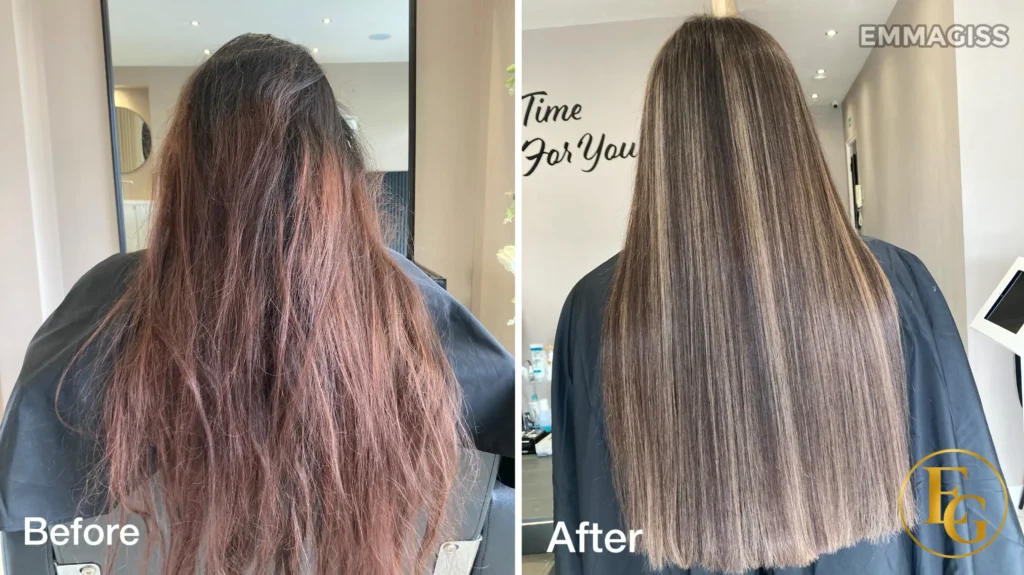
Because there are no harsh regrowth lines, balayage is an excellent choice if you prefer a lower-maintenance colour that doesn’t require frequent salon visits.
Balayage may be the right option if you:
- Want a natural, sun-kissed blonde.
- Prefer a softer grow-out with less visible regrowth.
- Would like added dimension and movement.
- Don’t want to colour your roots every few weeks.
Although balayage is lower maintenance than many other colouring techniques, regular toning treatments and professional aftercare can help keep your blonde looking fresh and minimise unwanted warmth between appointments.
3. Highlights – The Best Choice for Maximum Brightness
Highlights are one of the most versatile professional hair colouring techniques, designed to create a brighter, lighter appearance throughout the hair. Unlike balayage, which focuses on a soft, blended effect, highlights lift selected sections from closer to the roots, creating a more defined and luminous result.
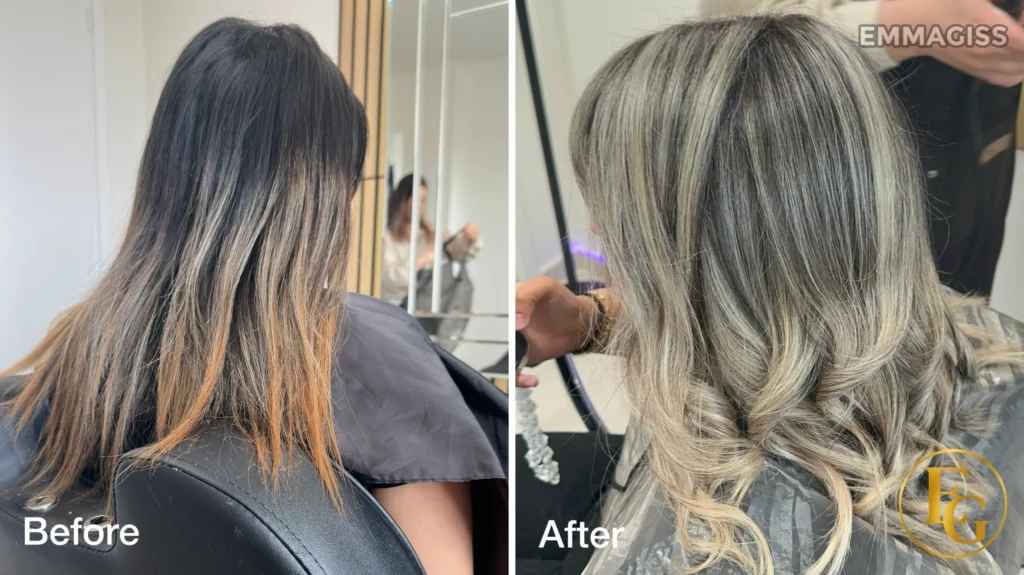
Depending on your desired look, your colourist may recommend a full head of highlights for maximum brightness or partial highlights to brighten specific areas while maintaining more of your natural colour.
Who are highlights best suited for?
Highlights are an excellent option if you:
- Want to achieve a brighter blonde.
- Prefer more even lightness from roots to ends.
- Would like to blend grey hair naturally.
- Enjoy a fresh, salon-maintained blonde look.
- Want more visible brightness than balayage usually provides.
Full Head vs Partial Highlights
The right option depends on how much lightness you’d like to achieve.
Full head highlights create brightness throughout your entire head, making them ideal if you’re looking for a complete blonde transformation or a consistently lighter appearance.
Partial highlights focus on selected areas, such as the top layers and around the face. They offer a softer refresh while requiring less processing time and maintenance.
Balayage vs Highlights
Although both techniques lighten the hair, they create very different results.
| Balayage | Highlights |
|---|---|
| Soft, hand-painted colour | Structured, evenly placed lightness |
| Natural grow-out | A brighter result from the roots |
| Lower maintenance | More frequent maintenance |
| Soft dimension | Maximum brightness |
Neither technique is better than the other—the right choice depends entirely on the result you’d like to achieve and how often you’re happy to maintain your colour.
How often do highlights need maintenance?
Because highlights begin closer to the roots, new hair growth becomes visible sooner than with balayage. Many people choose to refresh their highlights regularly to maintain a consistently bright appearance, while toners and professional aftercare can help preserve the colour between appointments.
4. Full Head Colour & Root Retouch – Understanding the Difference
Although full head colour and root retouch are often grouped together, they serve different purposes. Choosing the right service depends on whether you’d like to maintain your current colour, refresh faded hair or completely change your overall shade.
What is a Full Head Colour?
A full head colour involves applying colour from the roots through to the lengths and ends, creating a consistent result across the entire head of hair. This service is ideal if you want to change your current colour, refresh faded lengths or achieve even coverage from roots to ends.
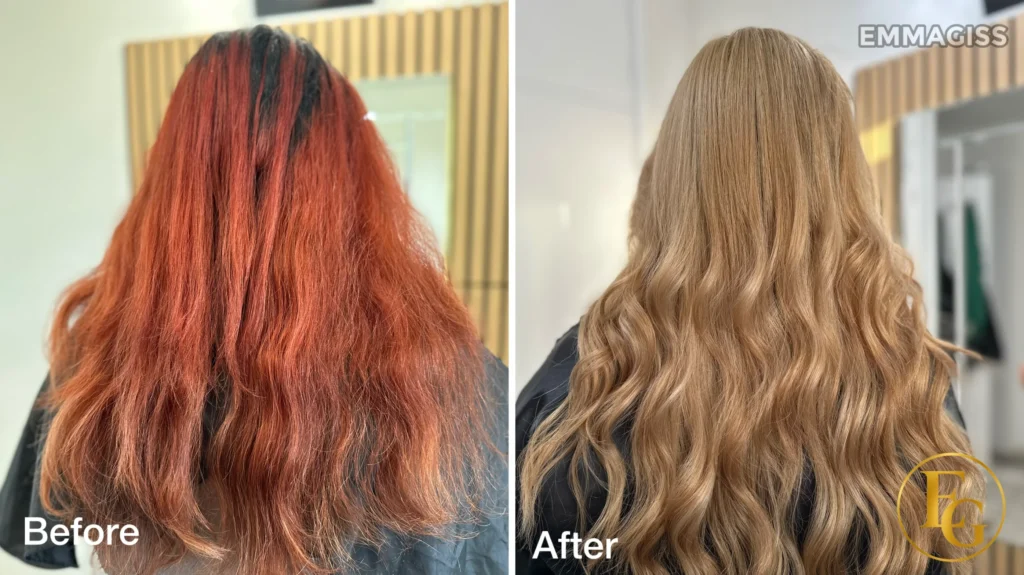
A full head colour may be suitable if you would like to
- Change your overall hair colour.
- Refresh faded or uneven colour.
- Create a richer brunette, copper, red or darker blonde.
- Achieve consistent grey coverage throughout your hair.
- Restore shine and depth to dull-looking colour.
However, colouring the entire head isn’t always necessary. If your lengths still look healthy and your colour remains vibrant, your colourist may recommend refreshing only the roots or using a toner or gloss instead of applying permanent colour throughout the hair.
What is a Root Retouch?
A root retouch focuses only on the new hair growth at the roots while leaving the previously coloured lengths untouched. It is designed to maintain your existing colour rather than create a completely new one.
A root retouch is often recommended if you:
- Need to cover new grey hair.
- Want to maintain your current shade.
- Have visible root regrowth.
- Are happy with the colour through your lengths and ends.
Because only the regrowth is coloured, this service usually requires less processing than recolouring the entire head and helps minimise unnecessary chemical exposure to previously coloured hair.
Full Head Colour vs Root Retouch
| Full Head Colour | Root Retouch |
|---|---|
| Colours the entire hair from roots to ends | Colours only the new root growth |
| Suitable for changing or refreshing the overall colour | Suitable for maintaining your existing colour |
| Ideal for faded or uneven lengths | Ideal for covering regrowth and grey roots |
| It usually involves more product and processing | Focuses only on the regrowth area |
Which Service Is Right for You?
If you’re happy with your current colour and only notice visible regrowth, a root retouch is usually the most appropriate option.
If your colour has faded, looks uneven or you’d like a completely different shade, a full head of colour may be the better choice.
During a professional consultation, your colourist will also consider your previous colour history, hair condition and long-term maintenance before recommending the most suitable treatment.
5. Why Your Hair History Matters Before Any Colour Service
Choosing the right hair colour service isn’t only about the look you’d like to achieve. Your previous colour history plays one of the biggest roles in determining what is safely possible, how many appointments may be required and the final result you can realistically expect.
Before recommending any colour service, a professional colourist should carefully assess your hair history rather than selecting a formula immediately.
Previous Hair Colour
Hair that has been coloured before behaves differently from natural hair. Permanent colour, semi-permanent colour and previous lightening services all affect how your hair will respond during your next appointment.
Understanding your colour history helps avoid uneven results and allows your colourist to choose the safest and most effective approach.
Previous Bleaching
Previously lightened hair is often more porous than untreated hair. While healthy bleached hair can usually be coloured successfully, over-processed hair may require a more gradual approach to protect its condition.
The strength, elasticity and overall health of your hair should always be evaluated before further lightening.
Box Dye
Home hair colour can make professional colour correction more unpredictable. Different brands contain different pigments, and multiple layers of box dye may react differently during professional lightening.
This doesn’t necessarily prevent you from becoming lighter, but it often requires a personalised plan and realistic expectations.
Henna and Metallic Salts
Natural henna and some metallic salt dyes can react unpredictably with professional colour products. In many cases, a strand test is recommended before beginning any lightening service.
Being honest about previous henna use helps your colourist protect both your hair and the final result.
Keratin Treatments
Some keratin treatments can influence how colour develops or how quickly it fades. Knowing when your last treatment was performed allows your colourist to recommend the most suitable timing for colouring your hair.
Hair Condition
Healthy hair generally provides the best foundation for beautiful colour.
If your hair is extremely dry, damaged or breaking, improving its condition first may produce a better long-term result than colouring immediately.
Why an Honest Consultation Matters
The more accurate information you share about your hair history, the more accurately your colourist can predict the final result.
A professional consultation isn’t about finding reasons to say “no”—it’s about creating the safest treatment plan, protecting your hair and helping you achieve the best possible outcome, whether that can be completed in one appointment or over multiple visits.
6. Toner & Gloss – The Secret Behind Beautiful Hair Colour
Many people believe that toner is a colour service on its own or that it can make hair significantly lighter. In reality, a toner is designed to refine, enhance and perfect your existing colour rather than dramatically change it.
Whether you’ve had balayage, highlights or a full blonde transformation, a toner is often the finishing step that gives your hair its final look.
What Does a Toner Do?
A toner works by adjusting the tone of previously coloured or lightened hair. Instead of lifting the hair lighter, it neutralises unwanted warmth or enhances certain tones to create a more polished, balanced result.
A professional toner can help to
- Neutralise unwanted yellow or orange tones.
- Create cooler, warmer or more neutral blondes.
- Add shine and dimension.
- Refresh faded colour between appointments.
- Improve the overall appearance of balayage and highlights.
Can a Toner Lighten Hair?
No.
A toner cannot significantly lighten dark hair or replace the bleaching process.
If your hair has not been lifted to the appropriate level, a toner alone cannot create a brighter blonde. Instead, it refines the colour that is already present.
This is one of the most common misconceptions in professional hair colouring.
Toner vs Hair Dye
Although both products contain colour pigments, they have different purposes.
| Toner | Permanent Hair Colour |
|---|---|
| Refines the existing tone | Changes the overall hair colour |
| Neutralises unwanted warmth | Can lighten or darken the hair (depending on the formula) |
| Usually used after lightening | Can be used on natural or previously coloured hair |
| Helps maintain blonde results | Creates a completely new colour |
When Might You Need a Toner?
A toner may be recommended if you:
- Have recently had balayage or highlights.
- Notice brassiness developing over time.
- Want to refresh your blonde without another lightening service.
- Prefer a cooler, warmer or more natural-looking finish.
- Would like to restore shine between colour appointments.
In many cases, a toner refresh appointment can extend the life of your colour while helping your hair maintain a fresh, salon-finished appearance.
How Long Does a Toner Last?
The longevity of a toner depends on several factors, including your hair condition, washing routine, heat styling habits and the products you use at home.
Using professional colour-safe shampoo, reducing excessive heat and following your colourist’s aftercare advice can help maintain your desired tone for longer.
7. Colour Correction – When a Standard Colour Service Is Not Enough
Colour correction is a specialised service designed to improve or repair an unwanted, uneven or technically difficult hair colour result.
It may be needed after repeated box dye, excessive darkness, uneven lightening, visible bands, unwanted warmth or a previous colour service that did not produce the expected result.
Unlike a standard colour appointment, colour correction usually requires a detailed assessment and a personalised plan. The process can vary considerably from one person to another because the safest solution depends on your colour history, hair condition and desired result.
When Might You Need Colour Correction?
You may need a colour correction service if your hair has the following:
- Uneven or patchy colour.
- Dark bands or visible lines between previous colours.
- Excessive orange, yellow, red or green tones.
- Several layers of dark or black box dye.
- Overly dark colour that you would like to lighten.
- Previously bleached areas that have lifted unevenly.
- A result that is significantly different from your intended colour.
- Different shades through the roots, mid-lengths and ends.
Not every unwanted tone requires a complete colour correction. Mild brassiness may sometimes be improved with a toner, while deeper colour problems may require pigment removal, controlled lightening, colour balancing or several carefully planned stages.
Toner vs Colour Correction
A toner refines the tone of hair that has already reached a suitable level of lightness. Colour correction addresses a more complex underlying colour problem.
| Toner | Colour Correction |
|---|---|
| Refines or neutralises an existing tone | Corrects uneven, unwanted or complex colour |
| Usually suitable for mild brassiness | May be needed for bands, box dye or major colour changes |
| Does not significantly lighten dark hair | May involve lightening, darkening or colour balancing |
| Often completed as a maintenance service | Requires an individual correction plan |
| Usually a simpler appointment | May take several hours or more than one appointment |
Why a Strand Test May Be Necessary
A strand test allows your colourist to assess how a small section of hair responds before carrying out a larger colour service.
It can help reveal:
- How easily the existing colour lifts.
- Which underlying pigments become visible.
- Whether the hair remains strong enough for the proposed process.
- Whether previous henna, metallic salts or box dye may affect the result.
- Whether the desired colour is realistic in one appointment.
A successful strand test cannot guarantee that every part of the hair will respond identically, especially when the hair contains different layers of previous colour. However, it provides valuable information for creating a safer and more realistic plan.
Can Colour Correction Be Completed in One Appointment?
Sometimes—but not always.
A relatively mild tonal problem may be corrected during one visit. More complex cases, particularly those involving years of dark dye, uneven bleach or compromised hair, may require several appointments.
Trying to achieve a dramatic transformation too quickly can place unnecessary stress on the hair. A gradual approach may provide a healthier, more even and more sustainable result.
What Affects the Final Result?
Several factors influence what can be achieved safely:
- Your natural hair colour.
- Previous permanent and semi-permanent colour.
- Box dye, henna or metallic salts.
- Previous bleaching and highlights.
- Hair strength, elasticity and porosity.
- The amount of colour build-up.
- Your desired level and tone.
- How much maintenance you are comfortable with.
For this reason, inspiration photos should be treated as a visual direction rather than a guaranteed result. Two people requesting the same colour may require completely different treatment plans.
Protecting Hair Health During Colour Correction
Healthy-looking hair should remain a priority throughout the correction process.
Depending on the condition of your hair, your colourist may recommend:
- A more gradual transformation.
- Bond-building treatments during or after colouring.
- Trimming damaged ends.
- A darker or warmer intermediate shade.
- Home-care products designed for coloured hair.
- Additional time between lightening appointments.
In some cases, the safest professional recommendation may be to postpone further lightening until the condition of the hair has improved.
What to Expect From a Colour Correction Consultation
A thorough consultation should include:
- A review of your complete colour history.
- An assessment of your current hair condition.
- Discussion of your desired result.
- An explanation of realistic limitations.
- A strand test when appropriate.
- An estimated treatment plan.
- Advice about maintenance and aftercare.
Colour correction is not simply about covering an unwanted shade. It involves understanding the pigments already present in the hair and creating the safest route towards a more balanced result.
10. Protecting Your Hair During Colour Services
Beautiful hair colour should never come at the expense of healthy hair. While modern professional colouring techniques are safer than ever, maintaining the strength and condition of your hair should always remain a priority.
A professional colourist doesn’t simply aim for the lightest blonde or the darkest brunette. The goal is to achieve the best possible colour while preserving the integrity of the hair throughout the process.
Why Hair Health Matters
Every colour service affects the hair differently. Factors such as previous bleaching, permanent colour, heat styling and chemical treatments all influence how your hair responds during colouring.
Hair that is already weakened may require a different approach to help minimise unnecessary stress and achieve a more predictable result.
Bond-Building Treatments
Modern bond-building treatments are designed to help support the internal structure of the hair during and after chemical services.
They may help:
- Reduce the risk of breakage during lightening.
- Improve the feel and appearance of damaged hair.
- Support stronger, healthier-looking results.
- Enhance shine and manageability.
- Maintain hair quality throughout a colour transformation.
These treatments are commonly used alongside services such as balayage, highlights, blonde transformations and colour correction, particularly when multiple lightening sessions are required.
Healthy Hair Creates Better Colour
Many people focus only on the shade they want to achieve. However, the condition of the hair has a significant influence on the final result.
Healthier hair often:
- Reflects light more evenly.
- Holds colour more consistently.
- Feels softer after colouring.
- Maintains its tone for longer.
- Styles more easily.
For this reason, professional colouring should always balance colour goals with long-term hair health.
Aftercare Is Part of the Colour Service
The appointment does not end when you leave the salon.
Looking after coloured hair at home plays an important role in maintaining both the colour and the condition of your hair.
Your colourist may recommend the following:
- Colour-safe shampoo and conditioner.
- Professional conditioning or bond-building treatments.
- Heat protection before styling.
- Limiting excessive heat exposure.
- Regular gloss or toner appointments when appropriate.
- Periodic trims to maintain healthy ends.
Following professional aftercare advice can help extend the life of your colour while keeping your hair looking healthier between appointments.
Every Hair Journey Is Different
Some clients achieve their desired result in a single visit, while others benefit from a gradual approach over multiple appointments.
Protecting the long-term condition of your hair is often more important than trying to reach an unrealistic result in one session. A personalised colour plan allows your hair to remain healthy while progressing safely towards your desired look.
11. How to Choose the Right Hair Colour Service
With so many professional colour services available, choosing the right one can sometimes feel overwhelming. The best option depends not only on the look you’d like to achieve, but also on your hair history, current condition and the level of maintenance you’re comfortable with.
Rather than asking, “Which service is the best?”, it’s more helpful to ask, “Which service is the right fit for my hair?”
Choose Balayage If…
Balayage may be the right choice if you:
- Prefer a soft, natural-looking blonde.
- Want lower-maintenance colour.
- Like a seamless blend between your natural roots and lighter lengths.
- Don’t want frequent root appointments.
- Prefer a lived-in, dimensional finish.
Choose Highlights If…
Highlights may be more suitable if you:
- Want a brighter, lighter overall blonde.
- Prefer colour closer to the roots.
- Would like maximum brightness.
- Want to blend grey hair with lighter tones.
- Don’t mind more regular maintenance.
Choose a Full Head Colour If…
A full head colour may be the best option if you:
- Want to completely change your hair colour.
- Need to refresh faded colour throughout your hair.
- Prefer a richer brunette, copper, red or darker blonde.
- Want consistent colour from roots to ends.
Choose a Root Retouch If…
A root retouch is usually appropriate if you:
- Are happy with your current colour.
- Simply need to cover regrowth or grey roots.
- Want to maintain your existing shade without colouring the lengths again.
Choose a Toner If…
A toner may be recommended if you:
- Notice unwanted warmth developing.
- Have recently had balayage or highlights.
- Want to refresh your blonde between appointments?
- Prefer a cooler, warmer or more neutral tone.
Choose Colour Correction If…
Colour correction may be necessary if you:
- Have uneven colour.
- Have multiple layers of previous dye.
- Experienced an unwanted colour result.
- Want to safely move from very dark to significantly lighter hair.
- Require a personalised correction plan rather than a standard colour service.
Still Unsure?
Sometimes, more than one service may be suitable.
For example, you may benefit from balayage combined with a toner, a root retouch followed by a gloss, or colour correction before beginning a blonde transformation.
A professional consultation allows your colourist to assess your hair, discuss your goals and recommend the safest and most appropriate treatment plan for your individual hair.
12. What to Expect During a Professional Hair Colour Consultation
One of the most important steps in achieving beautiful hair colour happens before any colour is mixed. A professional consultation allows your colourist to understand your hair, discuss your expectations and recommend the most suitable service for your individual needs.
Rather than choosing a treatment based on a photograph alone, a consultation helps create a realistic and personalised colour plan.
Your Hair History
Your colourist will usually ask about:
- Previous colouring services.
- Box dye history.
- Bleaching or highlights.
- Henna or metallic dyes.
- Keratin or smoothing treatments.
- Previous colour corrections.
These details help determine how your hair is likely to respond during the appointment.
Assessing Hair Condition
Healthy-looking colour starts with understanding the condition of your hair.
During the consultation, your colourist may assess:
- Hair strength.
- Elasticity.
- Porosity.
- Overall condition.
- Existing colour build-up.
- Natural hair level.
This assessment helps identify the safest approach before any colour service begins.
Understanding Your Goals
Reference photos can be extremely helpful, but they are used as inspiration rather than a guaranteed result.
Your colourist will discuss:
- Your preferred tone.
- How light or dark you would like your hair.
- The level of maintenance you’re comfortable with.
- Your daily styling routine.
- Whether your goal is realistic in one appointment.
Creating a Personalised Colour Plan
No two clients have exactly the same hair.
Even when two people request the same blonde or brunette shade, differences in hair history and condition often require different techniques and products.
For this reason, a professional colour plan may include the following:
- One colour service.
- A combination of services.
- Bond-building treatments.
- Toners or glosses.
- More than one appointment for complex transformations.
Setting Realistic Expectations
One of the most valuable parts of a consultation is understanding what can be achieved safely.
A responsible colourist will explain the following:
- The expected result.
- Any limitations.
- Whether multiple appointments may be required.
- How to maintain your colour afterwards.
Clear communication helps ensure that both you and your colourist are working towards the same goal.
Why Consultations Matter
The best colour results are rarely achieved by selecting a service without first assessing the hair.
A thorough consultation allows your colourist to recommend the safest technique, protect your hair and create a colour plan that suits your lifestyle, maintenance preferences and long-term hair goals.
13. Preparing for Your Hair Colour Appointment
Preparing for your appointment can help your colourist assess your hair more accurately and create the most suitable treatment plan. It also reduces the chance of misunderstandings and helps you achieve the best possible result.
Bring Inspiration, Not Expectations
Reference photos are an excellent way to communicate the style, tone and overall look you like. However, they should be treated as inspiration rather than an exact promise of the final result.
Hair colour is influenced by many individual factors, including your natural base colour, previous colour history and the condition of your hair. Two people can show the same inspiration photo and require completely different techniques to achieve a similar look.
Share Your Complete Hair History
Your colourist should know about any previous treatments, even if they were carried out several years ago.
Be prepared to mention:
- Permanent or semi-permanent hair colour.
- Box dye.
- Bleaching or highlights.
- Henna or metallic dyes.
- Keratin or smoothing treatments.
- Previous colour corrections.
Providing accurate information allows your colourist to create the safest and most effective colour plan.
Arrive With Clean or Natural Hair
Unless your colourist has given different instructions, hair does not need to be freshly washed immediately before most professional colour appointments.
Avoid applying heavy styling products, coloured root sprays or temporary colour products before your consultation, as these can make it more difficult to assess your natural colour and hair condition.
Allow Enough Time
Professional colour services vary significantly in length.
Simple maintenance appointments may take only a few hours, while balayage, blonde transformations or colour correction can require considerably more time depending on your starting point and desired result.
Planning enough time helps ensure your appointment is relaxed rather than rushed.
Be Open to Professional Advice
Sometimes the safest recommendation is not the one you expected.
A professional colourist may suggest the following:
- A different technique.
- A softer tone.
- A gradual lightening plan.
- Bond-building treatments.
- Multiple appointments.
These recommendations are made to protect your hair while working towards the best long-term result.
Healthy Expectations Create Better Results
The most successful colour appointments begin with clear communication, realistic expectations and a personalised treatment plan.
Working together with your colourist helps create beautiful results that suit both your hair and your lifestyle.
14. Common Hair Colour Myths
There is a lot of conflicting advice about hair colouring online. While some information is helpful, many common beliefs can create unrealistic expectations or lead to poor decisions. Understanding the facts can help you make more informed choices before your next colour appointment.
Myth: Hair Colour Always Damages Hair
Not necessarily.
Modern professional colouring techniques are designed to minimise unnecessary stress on the hair. The condition of your hair before colouring, the products used, the technique and your aftercare routine all influence how healthy your hair remains after the service.
Myth: Balayage Is Better Than Highlights
Neither service is better—they simply create different results.
Balayage is typically chosen for a softer, more natural transition, while highlights usually create a brighter and more uniform blonde from the roots.
The right choice depends on your hair goals rather than current trends.
Myth: A Toner Can Turn Dark Hair Blonde
No.
A toner adjusts the tone of hair that has already been lightened. It cannot replace the lightening process or significantly lift naturally dark hair.
Myth: One Photo Guarantees the Same Result
Hair colour is highly individual.
Your natural base colour, previous treatments, hair condition and colour history all influence what can be achieved safely. An inspiration photo is a useful guide, but it cannot guarantee an identical outcome.
Myth: Box Dye and Professional Colour Are the Same
Professional colour services involve personalised formulas, technical application and a consultation based on your individual hair.
Box dye is designed as a one-size-fits-most product and cannot take into account your unique hair history or condition.
Myth: Colour Correction Can Always Be Completed in One Appointment
Some colour corrections can be completed in one visit, while others require multiple appointments to protect the condition of the hair.
A gradual approach often produces healthier and more predictable long-term results.
The Most Important Truth
The best hair colour service is not the trendiest technique or the lightest blonde—it is the service that suits your hair, your lifestyle and the long-term health of your hair.
A professional consultation helps ensure that your colour journey is based on realistic expectations, personalised advice and techniques that prioritise both beautiful colour and healthy-looking hair.
15. Maintaining Your Hair Colour Between Appointments
Beautiful hair colour doesn’t depend solely on your salon appointment. The way you care for your hair at home plays a significant role in maintaining the tone, shine and overall appearance of your colour.
Whether you’ve chosen balayage, highlights, a full head colour or colour correction, following the right aftercare routine can help your results look fresher for longer.
Wash Less Frequently
Frequent washing can cause colour pigments to fade more quickly, particularly in blonde, copper and fashion shades.
If possible, washing your hair less often may help preserve both the colour and the overall condition of your hair.
Choose Colour-Safe Haircare
Professional colour-safe shampoos and conditioners are formulated to cleanse the hair more gently while helping maintain colour longevity.
Using products designed specifically for coloured hair may help reduce premature fading and keep the hair looking healthier between appointments.
Protect Your Hair From Heat
Heat styling can contribute to dryness, colour fading and loss of shine.
Whenever using hair dryers, straighteners or curling irons, applying a heat protectant can help reduce unnecessary stress on the hair.
Keep Your Hair Hydrated
Lightened and chemically treated hair often benefits from additional moisture.
Using a nourishing conditioner or hair mask regularly can improve softness, manageability and shine while helping coloured hair look healthier.
Book Maintenance Appointments
Professional maintenance appointments help keep your colour looking its best.
Depending on your chosen service, this may include:
- Toner refresh appointments.
- Root retouch appointments.
- Gloss treatments.
- Professional conditioning treatments.
- Periodic trims to maintain healthy ends.
Maintaining your colour regularly often produces more consistent long-term results than waiting until significant fading or regrowth has occurred.
Protect Your Hair From Environmental Factors
Sun exposure, chlorine and salt water can all affect coloured hair.
If you spend time outdoors or swim regularly, protecting your hair and rinsing it afterwards may help preserve both the tone and condition of your colour.
Healthy Hair Helps Colour Last Longer
The healthier your hair remains, the better it can reflect light, retain colour and maintain a smooth, glossy appearance.
Looking after your hair between appointments is one of the most effective ways to extend the life of your colour while reducing the need for more extensive corrective work in the future.
16. Frequently Asked Questions About Hair Colour Services
Which hair colour service is best for beginners?
There isn’t a single service that’s best for everyone. The right choice depends on your natural hair colour, previous colour history, desired result and how much maintenance you’re comfortable with. A professional consultation can help determine the most suitable option for your individual hair.
Is balayage lower maintenance than highlights?
In many cases, yes.
Balayage is designed to create a softer transition between the roots and lighter lengths, allowing regrowth to appear more natural. Highlights usually begin closer to the roots and often require more frequent maintenance appointments.
Can I go blonde if I have dark hair?
Often, yes—but the process depends on your starting colour and previous colour history.
Some people can achieve their desired blonde in one appointment, while others may require a gradual lightening plan to help protect the condition of their hair.
Will colouring damage my hair?
Professional colouring should always aim to balance beautiful results with healthy-looking hair.
The condition of your hair before colouring, the products used, the technique and your aftercare routine all influence how your hair looks and feels afterwards.
How often should I colour my hair?
The ideal maintenance schedule depends on the service you’ve chosen, your natural hair growth and your desired look.
For example, root maintenance appointments are generally needed more frequently than balayage refresh appointments.
Can I colour my hair after using box dye?
Often, yes.
However, previous box dye may affect how professional colour behaves, particularly when lightening the hair. Your colourist will usually assess your colour history before recommending the safest approach.
Do I need a consultation before booking?
For simple maintenance services, a consultation may not always be necessary.
However, it is strongly recommended for balayage, blonde transformations, colour correction or any significant colour change, as it allows your colourist to assess your hair and create a personalised treatment plan.
Can I achieve the exact colour shown in my inspiration photo?
Reference photos are extremely helpful for communicating your preferences, but the final result depends on factors such as your natural hair colour, previous treatments and overall hair condition.
Your inspiration photo should be viewed as a guide rather than a guaranteed outcome.
Should I wash my hair before a colour appointment?
Unless your colourist advises otherwise, clean, dry hair without heavy styling products is generally suitable for most colour consultations and appointments.
How do I make my hair colour last longer?
Using colour-safe haircare products, protecting your hair from excessive heat, following professional aftercare advice and attending maintenance appointments can all help preserve your colour for longer.
How to Choose the Right Hair Colourist
Choosing the right hair colour service is only part of the decision. The experience, knowledge and approach of your colourist can have an equally important impact on your final result.
A professional colourist should focus not only on achieving your desired look but also on protecting the long-term health of your hair.
Look for a Thorough Consultation
A professional consultation should involve more than simply choosing a colour from a photograph.
Your colourist should take time to understand:
- Your hair history.
- Previous colour services.
- The current condition of your hair.
- Your long-term hair goals.
- Your lifestyle and maintenance preferences.
This information helps determine the safest and most appropriate colour plan for your individual hair.
Experience Matters
Hair colouring combines technical knowledge with practical experience.
More complex services—such as balayage, blonde transformations and colour correction—often require advanced techniques, careful planning and an understanding of how different hair types respond to colour.
Healthy Hair Should Always Be a Priority
A responsible colourist should never recommend a service that places your hair at unnecessary risk.
Sometimes the safest recommendation is to lighten gradually, adjust expectations or divide the transformation across multiple appointments.
Protecting hair health should always come before achieving an unrealistic result in a single visit.
Look Beyond Social Media Photos
Beautiful before-and-after images can be inspiring, but they don’t tell the whole story.
Consider whether the salon also provides:
- Clear consultation processes.
- Transparent information.
- Hair health education.
- Genuine client reviews.
- Consistent colour work across different hair types.
These factors often provide a more complete picture of a colourist’s professionalism than photographs alone.
Ask Questions
A reputable colourist should be happy to explain the following:
- Which service they recommend.
- Why they recommend it.
- What results you can realistically expect.
- How your hair will be protected.
- How to maintain your colour after the appointment.
Clear communication helps build confidence before your appointment begins.
Trust Professional Advice
The best colourists don’t simply say “yes” to every request.
Instead, they recommend the approach that is most suitable for your hair, balancing your desired result with realistic expectations and long-term hair health.
Choosing a colourist who prioritises education, honesty and personalised advice can make a significant difference to both your experience and your final result.
Signs It’s Time to Refresh Your Hair Colour
Even the best professional hair colour changes over time. Natural hair growth, washing, heat styling and environmental factors can gradually affect the appearance of your colour.
Recognising the right time for a refresh can help keep your hair looking healthy, vibrant and well-maintained without waiting until a full colour correction becomes necessary.
Your colour looks dull
If your hair has lost its shine or appears flat compared to when it was first coloured, it may be time for a professional refresh.
A toner, gloss treatment or colour service can often restore brightness and enhance the overall appearance of your hair.
Brassiness Has Started to Appear
Blonde, highlighted and lightened hair may gradually develop unwanted warm or yellow tones.
A professional toner may help rebalance the tone and restore a cooler, softer or more natural-looking blonde, depending on your desired result.
Your Roots Are Becoming Noticeable
Visible regrowth is one of the most common reasons clients return to the salon.
Depending on your chosen colour service, your colourist may recommend the following:
- A root retouch.
- Root blending.
- Balayage refresh.
- Highlights.
- A complete colour refresh.
The most suitable option depends on your existing colour and long-term maintenance goals.
Your Hair No Longer Matches Your Original Goal
Hair colour naturally evolves over time.
If your colour no longer reflects the look you originally wanted, a consultation can help determine whether a toner, gloss, partial refresh or a more comprehensive colour service is the best solution.
Your Hair Feels Healthy, but the Colour Looks Tired
Sometimes the condition of the hair remains excellent while the colour simply loses its freshness.
In these situations, a relatively small maintenance appointment may be all that’s needed to restore shine, tone and dimension without repeating the entire colouring process.
When in Doubt, Ask a Professional
Every hair colour fades differently depending on the products used, your hair type and your daily routine.
If you’re unsure whether you need a toner, root retouch, balayage refresh or a completely new colour service, a professional consultation can help identify the most suitable next step while avoiding unnecessary treatments.
Still Unsure Which Hair Colour Service Is Right for You?
Choosing between balayage, highlights, full colour, a root retouch, toner or colour correction can feel confusing—especially when your hair has a previous colour history or you are planning a significant transformation.
A professional consultation can help you understand what is realistically achievable, which service is most suitable and how your hair can be protected throughout the process.
At Emmagiss, every colour journey begins with a personalised assessment of your
- Current hair colour and condition.
- Previous colouring and treatment history.
- Desired result and inspiration photos.
- Preferred level of maintenance.
- Lifestyle and long-term hair goals.
Based on this information, we can recommend a personalised colour plan rather than asking you to choose a technical service on your own.
Book a Personalised Hair Colour Consultation in Birmingham
Emmagiss is a private, appointment-only hair colour studio in Edgbaston, Birmingham, specialising in personalised balayage, highlights, blonde transformations and colour correction.
To receive initial guidance, you can send clear photographs of your current hair in natural daylight, together with your desired result and a brief description of your colour history.
Book your consultation and take the first step towards a hair colour plan created specifically for you.